The “We Miss You” Message That Wins Back Old Customers
Customer Reactivation, Client Retention, Marketing Automation
Customer Reactivation: Turning Past Customers into Your Fastest Growth Channel
As a senior software engineer working with sales and marketing teams, I’ve learned that the fastest wins rarely come from brand-new leads. They come from Customer Reactivation—systematically re-engaging past customers who already know, like, and trust your brand. With the right automation, message strategy, and data model, this becomes a predictable revenue engine instead of a one-off campaign.
Why Past Customers Are Your Lowest-Hanging Fruit
Most businesses are heavily optimized for acquisition: new leads, new funnels, new ads. Yet past customers have already crossed the trust barrier. They’ve paid you before, experienced your service, and are far more likely to buy again—if you give them a compelling reason and a frictionless path back in.
From a technical and economic perspective, reactivation has three key advantages:
Lower acquisition cost: You already paid to acquire these customers once; re-contacting them is inexpensive.
Higher conversion rates: Reactivation campaigns typically outperform cold outreach because of prior relationship and context.
Faster feedback loop: You can quickly validate offers and Client Retention Strategies using a smaller, warmer audience.
Connextion is built around this reality: if you can automatically identify dormant accounts, trigger the right We Miss You Message, and guide people through an Easy Booking Process, you can unlock revenue that’s currently sitting idle in your CRM.
Designing a Customer Reactivation Flow in Practice
Let’s look at Customer Reactivation the way an engineer would: as a deterministic workflow driven by data and state changes. At a high level, a reactivation pipeline for past customers should:
Identify inactive customers based on clear business rules (e.g., no purchase or appointment in 90 days).
Segment them by value, behavior, and last interaction to support Personalized Outreach.
Trigger a multi-channel We Miss You Message sequence (email, SMS, social DMs) via automation.
Provide a single-click path into an Easy Booking Process or offer redemption flow.
In Connextion, this translates into a workflow where events (like last_purchase_at or last_appointment_at) drive automation rules. Conceptually, the logic might look like this in Python pseudocode using a typical SaaS backend stack:
from datetime import datetime, timedelta

INACTIVITY_DAYS = 90

def is_inactive_customer(customer) -> bool:
    last_activity = max(
        customer.last_purchase_at or datetime.min,
        customer.last_appointment_at or datetime.min
    )
    return datetime.utcnow() - last_activity > timedelta(days=INACTIVITY_DAYS)

def build_we_miss_you_message(customer):
    first_name = customer.first_name or "there"
    return (
        f"Hi {first_name}, we miss you at {customer.brand_name}! "
        "We've added new services we think you'll love. "
        "Tap below to book your next visit in under 30 seconds."
    )

def enqueue_reactivation(customer, messaging_client):
    if not is_inactive_customer(customer):
        return

    message = build_we_miss_you_message(customer)
    # Connextion would fan this out across channels automatically
    messaging_client.send_email(customer.email, subject="We Miss You at Connextion", body=message)
    messaging_client.send_sms(customer.phone, message)

def run_reactivation_job(customers, messaging_client):
    for customer in customers:
        enqueue_reactivation(customer, messaging_client)
In production, Connextion encapsulates this type of logic in configurable workflows, so agencies and businesses can tailor Client Retention Strategies without touching code, while still benefiting from robust engineering patterns behind the scenes.
Crafting an Effective “We Miss You” Message
A We Miss You Message should feel human, specific, and action-oriented. Technically, it’s just a template. Strategically, it’s the emotional bridge that makes reactivation feel like a service, not a sales push. For agencies running campaigns on behalf of clients, reusable, parameterized templates are critical for scale.
Here is a simple example of a templated message with placeholders that Connextion or your own system could merge at send time:
WE_MISS_YOU_TEMPLATE = (
    "Hi {first_name}, it's {business_name}. "
    "We haven't seen you since {last_visit_date}, and we genuinely miss you. "
    "We're currently offering {offer_description} exclusively for returning clients. "
    "Use this link to book in seconds: {booking_link}"
)
When paired with a dynamic Easy Booking Process—for example, a pre-filled booking page with their preferred service and location—this message becomes a low-friction path back into your pipeline. Connextion automatically embeds personalized booking links that map to the right calendar, service, and team member, so your engineering team does not need to reinvent this infrastructure.
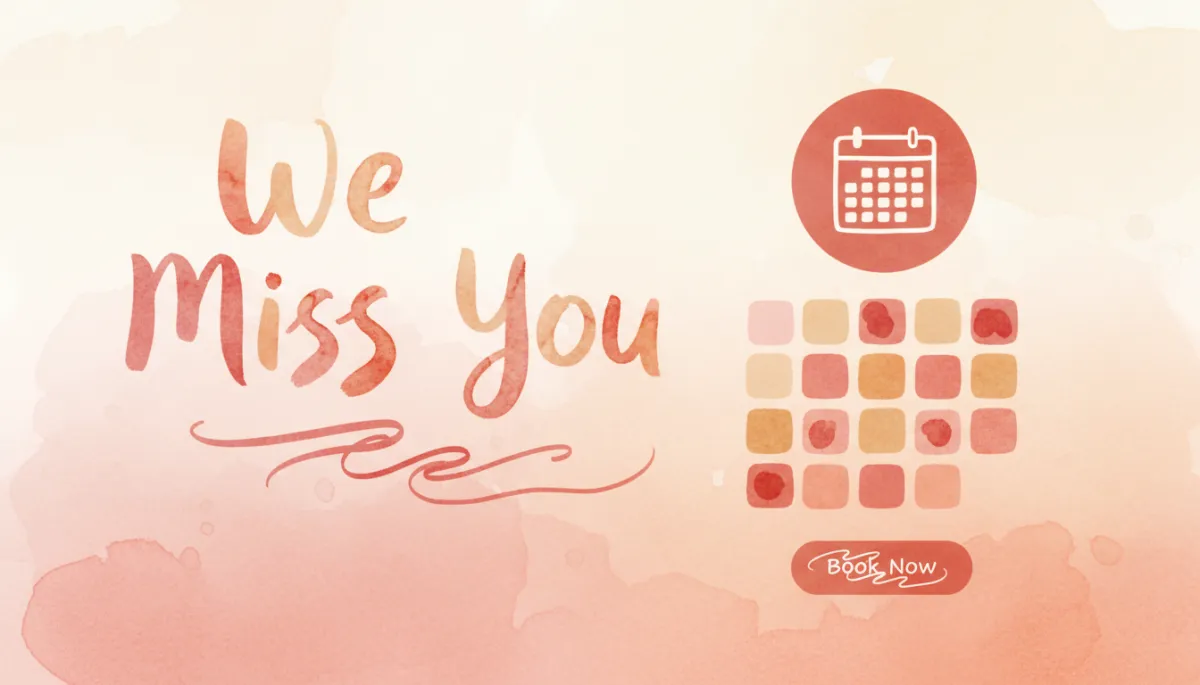
Pairing a We Miss You message with one-click booking dramatically improves reactivation rates.
Building an Easy Booking Process That Actually Gets Used
If your Customer Reactivation campaigns drive interest but your booking flow is clunky, you are leaking revenue. An Easy Booking Process should minimize cognitive load and clicks. From an engineering standpoint, that means:
Pre-filling known data (name, email, phone, preferred service) via secure tokens in the URL.
Presenting only relevant time slots based on the customer’s time zone and history.
Ensuring mobile responsiveness and sub-3-second load times for all booking pages.
A simplified example using a signed token to pre-fill booking data might look like this:
import jwt
from datetime import datetime, timedelta

SECRET_KEY = "change_me_in_production"

def generate_booking_token(customer_id, service_id):
    payload = {
        "sub": customer_id,
        "service_id": service_id,
        "exp": datetime.utcnow() + timedelta(days=7)
    }
    return jwt.encode(payload, SECRET_KEY, algorithm="HS256")

def build_booking_link(base_url, customer, service_id):
    token = generate_booking_token(customer.id, service_id)
    return f"{base_url}/book?token={token}"
Connextion abstracts this complexity for you, while still honoring data security and compliance. Tokens, permissions, and time-bound links are handled by the platform so agencies and business owners can focus on offers and messaging rather than cryptography and URL signing.
Personalized Outreach at Scale: From Static Lists to Smart Segments
True Personalized Outreach goes beyond dropping a first name into an email. It uses behavioral and transactional data to shape the offer, channel, and timing. As a developer, I think in terms of segmentation rules and event streams rather than static CSV exports.
For example, you might create segments such as:
High-LTV past customers who haven’t booked in 120 days.
Trial users who converted once but never returned.
Customers who only used one service when complementary services exist.
In SQL, a simple segment of inactive but historically valuable customers might look like:
SELECT
    c.id,
    c.first_name,
    c.email,
    c.phone,
    SUM(o.amount) AS lifetime_value,
    MAX(o.created_at) AS last_order_at
FROM customers c
JOIN orders o ON o.customer_id = c.id
GROUP BY c.id, c.first_name, c.email, c.phone
HAVING
    SUM(o.amount) > 500
    AND MAX(o.created_at) < NOW() - INTERVAL '120 days';
In Connextion, these rules are expressed as visual filters rather than raw SQL, but the principle is the same. You are encoding Client Retention Strategies into reusable, testable logic that determines who should receive which reactivation sequence.
Client Retention Strategies: Think Systems, Not One-Off Campaigns
For agencies and growth-focused businesses, the real leverage comes from turning Customer Reactivation into an always-on system. Instead of running a “win-back blast” once a year, you configure rules so that every time a customer crosses an inactivity threshold, the right sequence fires automatically.
Define inactivity thresholds by product or service line.
Map each threshold to a tailored We Miss You Message and offer.
Route responses into your sales pipeline with clear ownership and SLAs.
Connextion’s value here is orchestration. It connects your forms, calendars, email, SMS, and even call workflows, so your Client Retention Strategies are not scattered across tools. As a developer, this means fewer brittle integrations and more time spent on differentiating features instead of plumbing.
From Engineering to Revenue: Making Reactivation a First-Class Citizen
Customer Reactivation should sit alongside acquisition and onboarding in your system design. It deserves its own events, metrics, and dashboards: reactivated revenue, reactivated accounts, time-to-reactivation, and channel effectiveness. This is where Connextion’s analytics layer and transparency and actionable insights become critical for both technical and business stakeholders.
By treating past customers as an always-on growth channel, you:
Reduce volatility in monthly revenue with more predictable repeat business.
Increase customer lifetime value without proportional increases in ad spend.
Give your sales team warmer conversations and higher close rates.
Next Steps: Operationalizing Customer Reactivation with Connextion
As a senior engineer, my bias is always toward systems that are maintainable, observable, and secure. Connextion aligns with that mindset while giving your marketing and sales teams a user-friendly layer to design campaigns, personalize outreach, and manage bookings—without constantly pulling developers into the loop for small changes.
If you want to turn dormant contacts into a reliable growth engine, now is the time to formalize your approach to Customer Reactivation. Map your data, define your inactivity rules, design your We Miss You Message templates, and ensure your Easy Booking Process is truly frictionless. Connextion is designed to help you execute all of this with AI-powered automation, multi-channel communication, and robust analytics in a single platform.
📌 Key Takeaway: Your past customers are not “lost”; they are simply unactivated. With the right automation and messaging, you can systematically bring them back into your pipeline and scale revenue without scaling complexity.
If you are ready to make Customer Reactivation a core part of your growth strategy—without overloading your engineering team—Book Your Discovery Call Today with Connextion and see how quickly you can start reconnecting with the customers who already believe in you.